Wednesday, 8 June 2011

Orangutans

orangutan

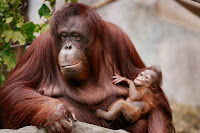
Orangutans are lonesome creatures . Adult males inhabit mainly alone and only come together with females to mate . Adult females live with their young. From time to time, adults will live with other grownups for short time periods in small temporary groups . Orangutans spend most of their lives in a "home range" of 0.4 to 3.7 square miles. Females have a smaller home range than males. Sometimes the home ranges of individual orangutans overlap.

Females are able to give birth after age seven, but in wild they generally do not mate until age 12. They give birth to one immature at a time, which clings to its mothers belly until it is about a year old . When an Pongo pygmaeus passes on adolescence at about four or five years , it gets more independent but may look for protective covering from its mother until it passes on seven to eight years .

Orangutans feed chiefly on fruits , specially wild figs. They besides eat other kinds of vegetation , insects, little vertebrates and birds eggs.

Orangutans are arboreal creatures , which means they spend most of their lives slowly walking, swinging and climbing through dense rain forests.

Species

Bornean Orangutan
orangutans

Common Name: Bornean orangutan; Orangoutan de Borneo(Fr); Orangután de Borneo(Sp)

Scientific Name: Pongo pygmaeus

Habitat: Tropical and Subtropical Moist Broadleaf Forests

Location: Borneo

Population: Central Bornean = 38,000; NW Bornean = 3,000


The Bornean orangutan is now recognised as a different species from its Sumatra relative. Three subspecieses are recognised : Pongo pygmaeus pygmaeus, P.p. morio, and P. p. wurmbii, the most common Bornean subspecies. Although extensive , the latter's habitat is progressively fragmentized in the remaining drench and lowland dipterocarp forests of Central and West Kalimantan.

It is approximated that about one third of Borneo's orangutan populations were lost during the 1997 98 forest fires. On the Indonesian side of Borneo, populations of this subspecieses are not getting along substantially either.

Although some populations inhabit inside protected surface areas, illegal logging stock still takes place within these area and therefore continues a major threat to the survival of this species .

Sumatran Orangutan

orangutans

Common Name: Sumatran orangutan;Orangoutan de Sumatra (Fr);Orangután de Sumatra (Sp)

Scientific Name: Pongo abelii

Habitat: Tropical and Subtropical Moist Broadleaf Forests

Location: Northern Sumatra

Population: Approximately 7,500 individuals in the wild

The Sumatran orangutan is the most critically endangered of the two orangutan species, and differs from its Borneo relative to upto some extents in physical appearance and behavioural language. Found only in the northern and western provinces of Sumatra, Indonesia, the species is losing fast its natural habitat to agriculture and human settlements.

Previous Post : Green Turtle

Saturday, 4 June 2011

World Environment Day 2011: Come celebrate nature


The World Environment Day is observed every year on the 5th of June. As such, it will be held on the same date in 2011. This day is special because it is the occasion when the United Nations (United Nations) creates a world wide consciousness of keeping the environment . Withal, it is not a public holiday.

World Environment Day is the day for worldwide activity and resoluteness toward continuing the environment goodly for one and all. The United Nations Environment Programme focuses on creating a cleaner and greener surround. Under this opening, activities are carried out throughout the class. Nonetheless, World Environment Day is the juncture when the natural processes pass on the climax. The United Nations has been taking exceptional openings and noticing this Clarence Day since 1972.

The World Environment Day 2011 idea is Forests : Nature at Your Service. The purpose of this melodic theme is to find out that extra importance is given to timberlands by different areas. In fact, this is the reason why the United Nations has declared 2011 as the International Year of Forests.

Under the United Nations Environment Programme, India has been declared the emcee of 2011 World Environment Day. The intent is to let India and other areas endeavor heavily through the process of modernizing a fleeceable saving. Holding this in mind, the World Environment Day 2011 musical theme has been declared as one which should assist peoples cosmopolitan understand why timberlands are important. This will assist them indulge in actions to conserve the timberlands and ascertain a gullible surroundings.

The locales for the ceremonial of World Environment Day 2011 in India are the cities, Delhi and Mumbai. A number of activities will be held in these locales just to create peoples aware of the positive aspects of a fleeceable surroundings.

World Environment Day is feted oecumenical amidst parades and progressions, concerts and hunting expeditions. You may ascertain similar kind of festivities on this extra day in 2011. Tree-planting and clean-up causes may be contracted to make sure the intact world creates an endeavour to maintain a fleeceable and clear surroundings. There are several areas which create utilisation of the consequences on the World Environment Day in order to look for political attention toward amending the surroundings. You may find out the same thing occurring this class as well.

The World Environment Day 2011 will hopefully reestablish the fact that the environment calls for to be written. This is important, as other than the present and future generations cant hold a healthy living out front.

Previous Post : Green Turtle

Friday, 3 June 2011

Green Turtle

green turtle

Common Name: Green turtle; Tortue comestible, tortue franche, tortue verte (Fr); Tortuga blanca, tortuga verde (Sp)

Scientific Name: Chelonia mydas

Population: Approx. 203,000 nesting females

This big, thoroughly aquatic turtle seldom comes to land except to bask and sleep and to lay eggs . Males have slimly longer, narrower shells than females and enlarged curved claws on the front flippers for grappling the female when mating . Green turtles are mainly herbivorous creatures and have serrated jaw surfaces, considerably suited to feeding on sea grasses and seaweed ; some crustaceans and jellyfish may also be eaten .

green turtle

Scope of Green TurtleThe best feeding lands, where there are immense submerged pastures of plants , are often far away from the best nesting beaches, and green turtles have evolved astounding migratory habits . At nesting time they locomote hundreds of sea miles to the beach of their birth to lay eggs, and as a result, there tend to be a limited number of significant nesting sites , to which hundreds of turtles go. One such site is Ascension Island in the mid atlantic . Every second or third year, green turtles travel to their nesting site and mate . The female heaves herself up the beach well away from the tidal area . With her foreflippers she sweeps away sand to create a hollow to lie in, her shell flush with the beach. She then utilizes her hind flippers to dig a hole about 40 cm (16 in) deep , immediately beneath her tail. She deposits her eggs into the hole, covers the area with sand and returns to the sea. The average grip contains about 106 eggs. Sometimes a female lays several clutches in a season at 2-week intervals. After a 2 - to 3-month incubation period, the young turtles hatch and dig their way through the sand to the surface. Having oriented themselves, they rush for the sea, past a horde of eager predators. Deathrate is high, and those which do reach the sea will have to face so far more predators.

The green turtle is now an endangered species, and the population has been eliminated in some areas , although it is still reasonable in others. The turtles have been overexploited for their meat, hides and eggs, and the predictability of their nesting habits has created them easy dupes. Exploitation is now strictly mastered, and imports are banned in many countries. The closely related flatback turtle, C. depressa, is a little smaller than the green turtle and inhabits off the sea coast of Northern Australia.

Previous Post : Polar Bear

Tuesday, 31 May 2011

Polar Bear

polar bear

Common Name: Polar bear Ours blanc; ours polaire (Fr); Oso polar (Sp)

Scientific Name: Ursus maritimus

Habitat: Arctic

Location: Arctic (northern hemisphere)

Biogeographic realm: Nearctic and Palearctic

Ecological region: Alaskan North Slope Coastal Tundra, Canadian Low Arctic Tundra, Taimyr and Siberian Coastal Tundra, Chukote Coastal Tundra, Bering-Beaufort-Chukchi Seas, Barents - Kara Seas, Grand Banks, Canada

The polar bear has many unique adaptations inorder to deal with the Arctic cold. The polar bear's skin is black in actual, which allows it to soak up as much heat as possible from the sun. They are great swimmers and will swim from one ice floe to othe ice floe. They have been seen swimming at a distance of 50 miles away from any ice or land.

Range: Polar bears spend their entire life associated with pack ice. Females usually prefer ice along the shoreline while others prefer moving sea ice at the floe edge -usually within 180 miles of shore.

Diet: Polar bears eat mostly ringed and bearded seals. They occasionally eat other mammals, eggs, vegetation and beach-cast carrion. They don't drink water. They get all the liquids that they need from the animals that they consume.

polar bear

Polar bears have fur that is basically made up of "hollow guard hairs". The ones that are kept in zoo's that are in warmer climate, can have algae growind inside hollow guard hairs of fur. This makes them have a greenish tint to their fur. These hollow hairs also keep their hair from matting down when they swim in water.

Polar bears have a technique for catching the seals present in the freezing water under the ice floor. They find a seal air hole and sneak up on it slowly and sit there until a seal comes up to breathe and then they scoop him right out of the hole.

Previous Post : Vaquita -- Smallest Porpoise in the world

Monday, 23 May 2011

Vaquita -- Smallest Porpoise in the world

vaquita


Common Name: Vaquita, cochito, Gulf of California porpoise, gulf porpoise ; Cochito, marsouin du Golfe de Californie, vaquita (Fr); Cochito, vaquita(Sp)

Scientific Name: Phocoena sinus

Habitat: Tropical upwelling

Location: Upper Gulf of California, Mexico

Population: Estimated around 245 individuals

The vaquita is the smallest living cetacean, weighing up to 55 kg (120 lb). It resembles the common porpoise. The main body color is gray, darker above than below and also around the eyes and mouth. There is a dark stripe from the chin to the base of the flipper. The vaquita lives in shallow lagoons along the shoreline where there is strong tidal mixing and high productivity of the aquatic plant and animal communities.

The vaquita appears to be a non-selective feeder on small bottom-dwelling fish and squid. It swims and feeds in a leisurely manner, but it is elusive and will avoid boats of any kind. High-frequency clicks are used for echolocation. The vaquita occurs singly or in small groups, usually from 1 - 3 individuals but as many as 8 - 10.

The vaquita may have formerly occurred in Mexico throughout the Gulf of California. It was considered abundant in the early 20th century. As of the early 1980's, the only recent records of its occurrence were from the northern part of the Gulf of California. Currently it has the most limited distribution of any marine cetacean. It is restricted to the northwestern corner of the Gulf of California.

The vaquita declined in conjunction with the intensification and modernization of commercial fisheries, starting in the 1940's. Currently, the fisheries aimed at a variety of species are intensive in the upper Gulf of California, and the incidental trapping and drowning of vaquitas, particularly in gill and trawl nets, is their principal threat. In addition, the vaquita's habitat has been drastically altered by damming of the Colorado River in the USA. Long-term changes due to the reduced freshwater input are matters of concern. However, the immediate priority is to eliminate the bycatch of vaquitas in fishing gear.

Diet: All of the 17 fish species that have been found in vaquita stomachs can be classified as demersal and/or benthic species inhabiting relatively shallow water in the upper Gulf of California. The vaquita is a rather non-selective feeder on small fish and squid. Squid remains were also found in several stomach samples.

Behavior: The vaquita appears to swim and feed in a leisurely manner, but it is elusive and will avoid boats of any kind. It rises to breathe with a slow, forward-rolling movement that barely disturbs the surface of the water, and then disappears quickly, often for a long time. The vaquita uses high-frequency clicks for echolocation. Vaquita's are generally solitary animals unless accompanied by a calf.

Social Organization: The vaquita occurs singly or in small groups. One report indicated that in 58 sightings, 91 % comprised from one to three individuals, with a mean group size of 1.9 and a range of 1 - 7. Loose aggregations of vaquitas, in which they were dispersed as single individuals or as small subgroups (from two to four members, greatest number eight to ten) throughout several hundred sq m (several thousand sq ft) were also reported.

Size and weight: Length: Females - up to 1.5 m (5'); males - up to 1.4 m (4.6'). Weight: up to 55 kg (120 lb).

Age to Maturity: Females may become sexually mature at a length of approximately 1.3 m (4.4').

Gestation Period & Birth Season/Rate: The gestation period is probably 10 - 11 months. Births are thought to occur generally around late March or early April. Female vaquita's produces 1 calf annually.

Development: A vaquita calf is weaned after two to three months. The maximum observed age is 21 years.

Population status: The most recent population census calculated there are only 150 animals remaining. The mortality rate for the vaquita is estimated at 30 animals a year killed by drowning in fishing nets. If this trend continues the species will become extinct by the year 2015. There are no vaquita's in captivity to promote captive breeding to increase the population.

Previous Post : Giant Panda

Thursday, 19 May 2011

Giant Panda

giant panda


The giant panda is the rarest member of the bear family and among the world’s most threatened animals. It is universally loved, and has a special significance for WWF as it has been the organization's logo since 1961, the year WWF was founded.

Today, the giant panda's future remains uncertain. As China's economy continues rapidly developing, this bamboo-eating member of the bear family faces a number of threats. Its forest habitat, in the mountainous areas of southwest China, is increasingly fragmented by roads and railroads. Habitat loss continues to occur outside of protected areas, while poaching remains an ever-present threat.

giant panda

Common Name: Giant panda
Scientific Name: Ailuropoda melanoleuca
Location: Southwest China (Gansu, Shaanxi, and Sichuan Provinces) to the east of the Tibetan plateau.
Population: Less than 2,500 mature in the wild

Great strides have been made in recent years to conserve the giant pandas. By 2005, the Chinese government had established over 50 panda reserves, protecting more than 2.5 million acres - over 45 percent of remaining giant panda habitat – protecting more than 60 percent of the population.

Giant pandas are solitary. They have a highly developed sense of smell that males use to avoid each other and to find females for mating in the spring. After a five-month pregnancy, females give birth to a cub or two, though they cannot care for both twins. The blind infants weigh only 5 ounces (142 grams) at birth and cannot crawl until they reach three months of age. They are born white, and develop their much loved coloring later.

There are only about 1,000 giant pandas left in the wild. Perhaps 100 pandas live in zoos, where they are always among the most popular attractions. Much of what we know about pandas comes from study of these zoo animals, because their wild cousins are so rare and elusive.

The panda’s habitat in the Yangtze Basin ecoregion is shared by both pandas and millions of people who use the region's natural resources. This ecoregion is the geographic and economic heart of China. It is also critical for biodiversity conservation. Its diverse habitats contain many rare, endemic and endangered flora and fauna, the best known being the giant panda.

Economic benefits derived from the Yangtze Basin include tourism, subsistence fisheries and agriculture, transport, hydropower and water resources. The survival of the panda and the protection of its habitat will ensure that people living in the region continue to reap ecosystem benefits for many generations.

Previous Post : Rhinoceros--Very few of them survive outside

Saturday, 14 May 2011

Rhinoceros--Very few of them survive outside

One more species, that is very rare in the world now, is a huge weighted, giant beast -- Rhinoceros


rhinoceros


Rhinos once roamed Europe, Asia and Africa and were known by early Europeans who depicted them in cave paintings. In historical times, rhinos were still widespread in the African savannas and the tropical forests of Asia.

Today, very few rhinos survive outside national parks and reserves. Rhinos are threatened by poaching due to the demand for their horns, and habitat loss, a result of human populations encroaching on the land and the destruction of forests. WWF works to strengthen protected areas in Africa and Asia and stop illegal trade of rhino horns.

The southern white rhino, once thought to be extinct, and the Indian rhino are thriving in well-protected sanctuaries and their numbers are increasing. Black rhino populations have increased too, but total numbers are still a fraction of what they were fifty years ago.

Rhinoceroses are universally recognized because of their massive bodies, short legs and one or two horns. In some rhino species the horn is small and not easily visible. Rhinos have poor eyesight, but their sense of smell and hearing are well developed.


Five species of rhinos


rhinoceros


Black Rhinoceros
Scientific Name: Diceros bicornis
Habitat: tropical and subtropical grasslands, savannas and deserts
Location: East, Central, West and South Africa
Population: approximately 3,725 individuals


javan rhinoceros


Sumatran Rhinoceros
Scientific Name: Dicerorhinus sumatrensis harrissoni
Habitat: lowland swamps and forests with thick vegetation
Location: northern Borneo. Borneo is the third largest island in the world, located north of Australia. The island is made up of the countries of Malaysia, Indonesia and Brunei.
Population: Fewer than 25


rhino


Indian Rhinoceros
Common Name: Indian rhino, greater one-horned rhinoceros; Rhinocéros unicorne de l'Inde (Fr); Rinoceronte unicornio índico (Sp)
Scientific Name: Rhinoceros unicornis
Habitat: Tropical and Subtropical Grasslands, Savannas, and Shrublands
Location: Southern Asia, northern margin of the Indian subcontinent adjacent to the southern slope of the Himalayas
Population: Around 2,400 individuals


indian rhinoceros


Javan Rhinoceros
Common Name: Javan rhinoceros, lesser one-horned rhino
Scientific Name: Rhinoceros sondaicus
Habitat: Tropical and Subtropical Moist Broadleaf Forests
Location: Western Indonesia, Eastern Indochina
Population: 40-60 in Ujung Kulon National Park, Java, Indonesia; no more than 8 in Cat Tien National Park, Vietnam


Previous Post : Tiger-Somewhat back from 'low' now

Wednesday, 11 May 2011

Tiger - The Endangered Species


Let me start with the national animal of my country, which is critically endangered, even after being the national animal -- TIGER


tiger


As few as 1706

Wild tiger numbers are at an all-time low. The largest of all the Asian big cats may be on top of the food chain and one of the most culturally important and best-loved animals, but they are also vulnerable to extinction. Tigers are forced to compete for space with dense human populations, face unrelenting pressure from poaching, retaliatory killings and habitat loss across their range.


There is still hope

We can save wild tigers. WWF has set a bold but achievable goal of Tx2: doubling the number of tigers in the wild by 2022, when the next Year of the Tiger is celebrated. We are concentrating our efforts on protecting key landscapes where the big cats have the best chance of surviving and increasing over the long-term. Five decades of conservation experience has shown us that given enough space, prey and protection, tigers can recover.

By saving tigers, we also save the biologically rich and diverse landscapes where they still roam — Asia’s last great rain forests, jungles and wild lands. These forests are home to thousands of other species, people and the food, freshwater and flood protection that local communities need to survive.


Subspecies


siberian tiger


Amur (Siberian) Tiger


Scientific name: Panthera tigris altaica

IUCN Listing: Endangered

Habitat: Coniferous, scrub oak and birch woodlands

Location: Primarily eastern Russia, with a few found in northeastern China

Interesting Fact: In the 1940s the Amur tiger was on the brink of extinction, with no more than 40 tigers remaining in the wild. Thanks to vigorous anti-poaching and other conservation efforts by the Russians with support from many partners, including WWF, the Amur tiger population recovered and has remained stable throughout the last decade.


bengal tiger


Bengal (Indian) Tiger


Scientific name: Panthera tigris tigris

IUCN Listing: Endangered

Habitat: Dry and wet deciduous forests, grassland and temperate forests, mangrove forests

Location: Bangladesh, Bhutan, China, India, Myanmar and Nepal. India is home to the largest population.


Interesting Fact: Some Bengal tigers are cream or white in color instead of orange, due to a recessive gene for this coloration. These "white" tigers are rarely found in the wild.


indochinese tiger


Indochinese Tiger


Scientific name: Panthera tigris corbetti

IUCN Listing: Endangered

Habitat: Remote forests in hilly to mountainous terrain, much of which lies along the borders between countries

Location: Widely dispersed throughout six countries: Thailand, Cambodia, China, Lao PDR, Myanmar, and Vietnam.

Interesting Fact: Access to the areas where Indochinese tigers live is often restricted, and biologists have only recently been granted limited permits for field surveys. As a result, relatively little is known about the status of these tigers in the wild.


malayan tiger


Malayan Tiger


Scientific name: Panthera tigris jacksoni

IUCN Listing: Endangered

Habitat: Tropical and subtropical moist broadleaf forests

Location: Southern tip of Thailand and Peninsular Malaysia

Interesting Fact: The Malayan tiger was only identified as being a separate subspecies from the Indochinese tiger in 2004. It is very similar to the Indochinese tiger, but is smaller in size.


endangered species


South China Tiger


Scientific name: Panthera tigris amoyensis

IUCN Listing: Critically Endangered

Habitat: Montane sub-tropical evergreen forest

Location: Central and eastern China

Interesting Fact: It is estimated that the South China tiger is functionally extinct. Currently 47 South China tigers live in 18 zoos, all in China. If there are any South China tigers in the wild, these few individuals would be found in southeast China, close to provincial borders.


endangered species


Sumatran Tiger


Scientific name: Panthera tigris sumatrae

IUCN Listing: Critically Endangered

Habitat: Montane forests, the remaining blocks of the island's lowland forest, peat swamps, and freshwater swamp forests

Location: Exclusively on the Indonesian island of Sumatra

Interesting Fact: Sumatran tigers are protected by law in Indonesia, with tough provisions for jail time and steep fines. Despite increased efforts in tiger conservation, including law enforcement and anti-poaching capacity, a substantial market remains in Sumatra for tiger parts and products.

Tuesday, 10 May 2011

Dedicated to Wildlife around the globe....

The site is dedicated to raise awareness and to help saving Wildlife and Endangered Animals from around the world and bring about awareness for each and every one of these beautiful creatures. It is our hope that through Endangered Species Awareness, each one of us can make a difference.

I would publish the details of the most endangered animals on the earth from the next few posts. Also, I would mention the updates that take place worldwide, related to animal kingdom.